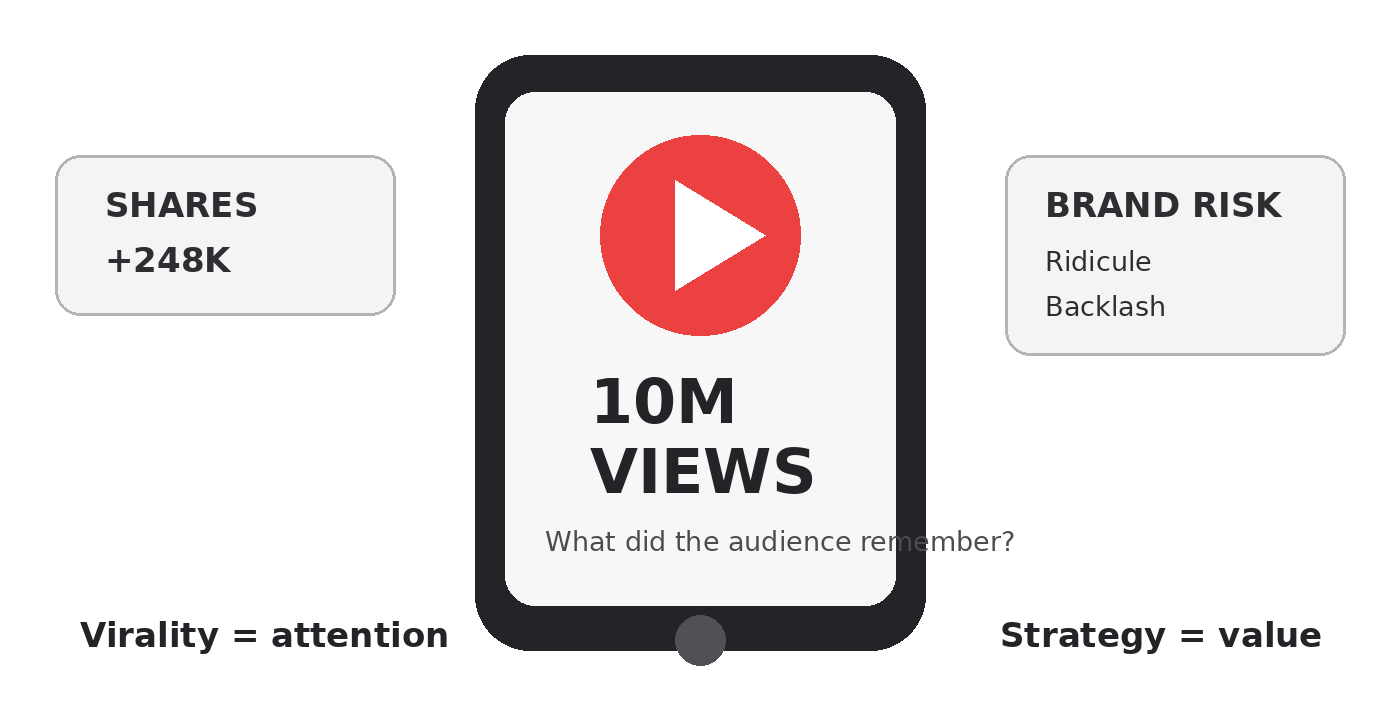
Viral reach can look like success on a dashboard, but the real marketing question is whether the attention strengthens the brand.
Going viral is often treated like the ultimate marketing win. Millions of views, thousands of shares, and a brand suddenly becoming part of the online conversation sounds like exactly what marketers want. But attention alone does not equal success.
When attention becomes the problem
Brands cannot completely control why people share something. A video created to be funny can be interpreted as offensive. A serious message can become a meme. An influencer partnership can generate enormous attention while leaving audiences talking more about the controversy than the product. Once that happens, the original marketing message can quickly become secondary to the conversation happening around it.
Going viral only helps a brand when the attention reinforces what the brand wants to be known for.
That distinction matters because reach is only one piece of effective marketing communication. If millions of people see a video but walk away with a negative impression, those views may actually be working against the brand. Research highlighted by the American Marketing Association also shows that negative social media exposure can motivate even highly connected consumers to distance themselves from a brand.
Views are not the same as value
This is where marketers have to be careful about treating engagement metrics as automatic proof of success. A video with ten million views may look more successful on a dashboard than one with 500,000, but a smaller audience leaving with the right message can be more valuable than millions remembering the brand for the wrong reason.
The same applies when brands jump onto viral trends simply because they are popular. If the humor, language, or trend does not naturally fit the brand or its target audience, the content can feel forced. Consumers are quick to recognize when a company is trying too hard to participate in an online moment.
Plan for the attention you want
Before chasing virality, marketers should ask a different question: If ten million people see this tomorrow, what do we want those ten million people to think, feel, or do afterward?
That question shifts the focus from simply getting attention to getting the right attention. Virality can be incredibly valuable, but only when it supports the larger marketing strategy. The goal should never be to become the conversation at any cost. The goal is to create a conversation that makes the brand stronger.
AI use disclosure: Generative AI was used to assist with organization, title development, proofreading, formatting, and creation of the accompanying original visual.